
GenAI Phase 2
Moonshots to Market Value

The artificial intelligence landscape is in flux, not just regarding talent movement, but slowly shifting in its fundamental focus. As the initial hype around AGI (Artificial General Intelligence) and consumer-facing chatbots begins to settle, the industry is entering a crucial phase: proving its real-world value. The next wave of AI innovation isn't just about pushing technological boundaries; it's about demonstrating tangible ROI that can justify the enormous valuations, and investments pouring into the sector.
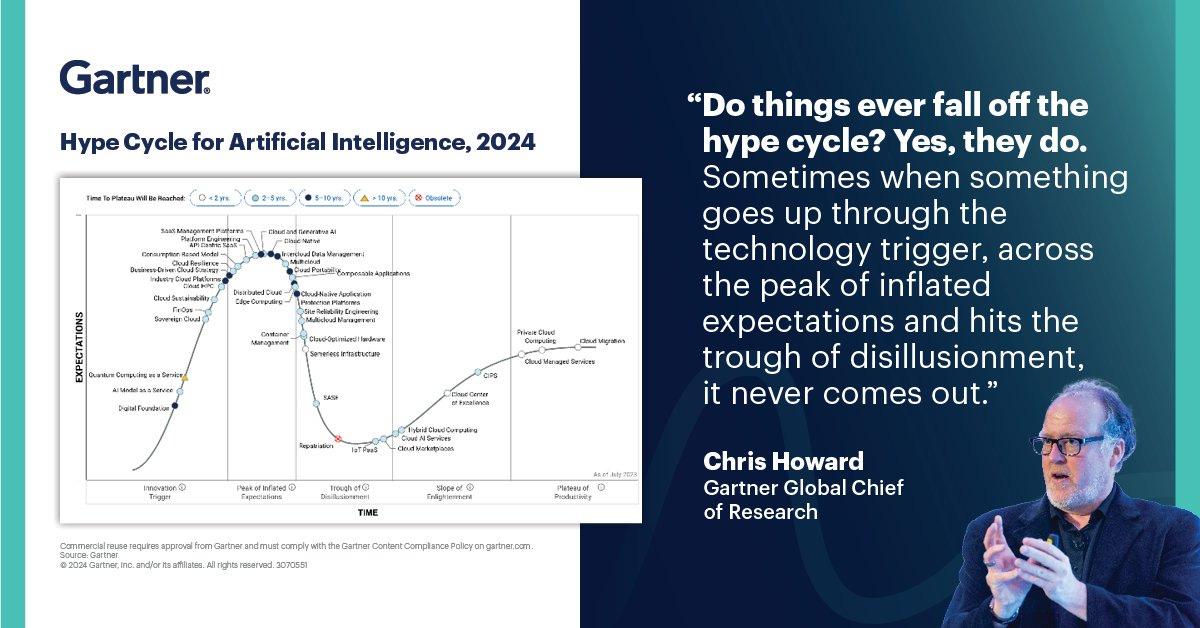
In recent months, many in the business world have begun to question the return on investment (ROI) of hardware buildouts and proof of concepts (POCs). This skepticism is partly due to the Gartner Hype Cycle, which highlights the fluctuating expectations and adoption stages of technologies like large language models (LLMs) and Generative AI. According to Gartner, by the end of 2025, 30% of generative AI projects are expected to be abandoned after the POC stage due to challenges such as poor data quality. LLMs and Generative AI present unique challenges within the hype cycle, as some are fully developed products, others fuel products, and some remain theoretical. Generative AI in the media and popular culture is often discussed in a science fiction context, making broad generalizations about capabilities that may or may not exist. However, understanding the users and use cases for LLMs and generative AI is far more complicated.
While it is true that many consumers and businesses have tried and passed on the use of generative AI, it is also clear that advanced users often employ multiple models. Most of the people in our orbit (early adopters) cross-reference models such as Perplexity, ChatGPT, and Claude, to find the best answer or foster a "team of rivals" approach, aiding in editing, decision-making, and ideation, or design systems that use smaller models for specific use cases. The idea that a language (even an AI Chatbot) model is just one part of a technology stack and not an “Autonomous AI robot” is hard to grasp for those who do not directly work with or understand AI models. The portrayal of AI in media as either emotional partners or apocalyptic threats contributes to this misconception, affecting how people perceive the actual capabilities and roles of AI systems in technology. This becomes even more important with recent advances in conversational systems and our previously outlined human tendency to anthropomorphize objects and animals we identify with.
OpenAI's Shake-up: A Catalyst for Change
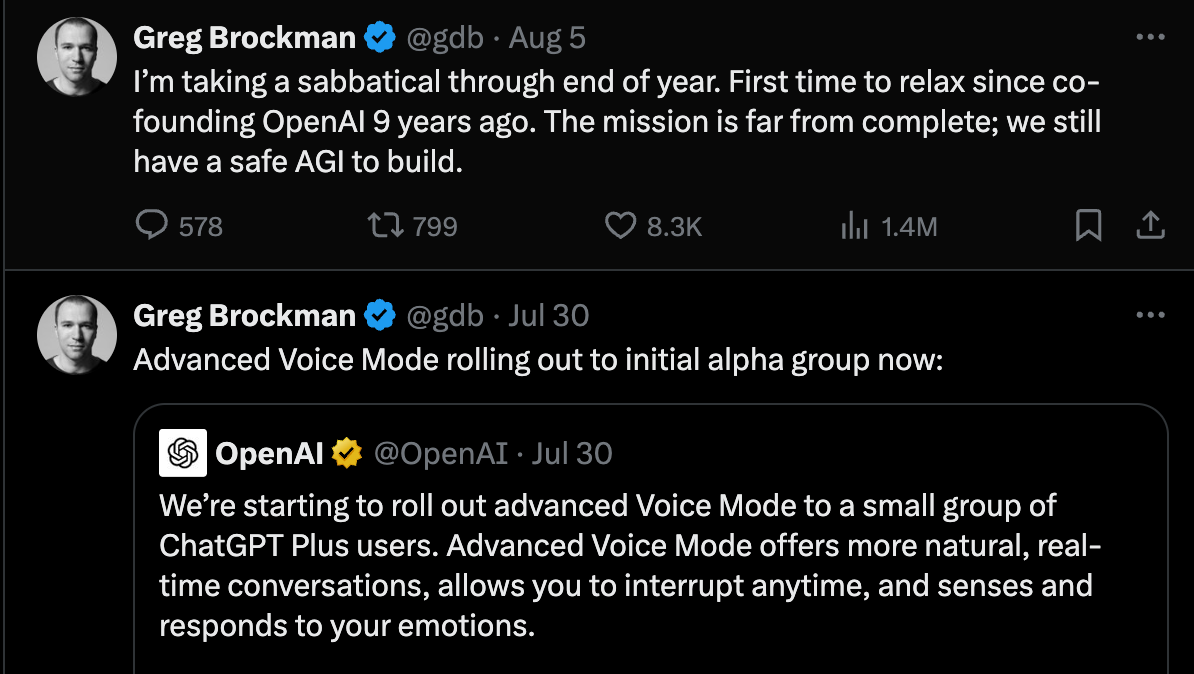
OpenAI has been shaking things up in both Products and Personnel. Hot on the heels of SearchGPT and a slow rollout of the much-anticipated voice mode Co-founder Greg Brockman has announced a sabbatical, while John Schulman another founding member (and possibly the last researcher with enough sway to puch back) has left for the greener pastures of Anthropic. This time it is notable that both departed on good terms without a fiery angsty breakup letter.
Meanwhile, Google has decided to start reeling back it’s top talent defectors. In a dealsimilar to Microsofts coup to hire Mustafa Suleyman and the top talent from his Pie team, Google is going to absorb the Character AI team. This is notable as Character AI is one of the most successful Generative AI companies in terms of Monthly and Daily active users and time spent with models. Also interesting in this deal is the likelihood that Character AI will run Meta’s Llama3.1 models instead of Google’s amazing new Gemini models. This may be an effort to skirt any antitrust interest the government may have concerning ongoing litigation.
The "Attention Is All You Need" Legacy: Where Are They Now?
Character.AI, co-founded by Daniel De Freitas and Noam Shazeer, two ex-Googlers who respectively spearheaded the infamous LaMBDA language model project, and co-wrote the groundbreaking paper Attention Is All You Need. This seminal work, which introduced the Transformer model, has become the cornerstone of modern natural language processing. Its authors have since scattered across the AI landscape, each pursuing their unique vision. In light of these moves among the language model elites, I have created a table of the Authors of the paper and their current vocations:
Ashish Vaswani: Co-founder of Adept.ai, which recently raised $350 million to build LLM generative AI tools for software. He has since left Adept for a stealth startup.
Noam Shazeer: Co-founder of Character.ai, a platform for creating and interacting with advanced AI characters.
Niki Parmar: Formerly part of Google Brain, she joined Adept.ai and has since left for a stealth startup with Ashish Vaswani.
Jakob Uszkoreit: Co-founder of Inceptive, a company focused on AI and machine learning.
Llion Jones: Co-founder of Sakana AI, a startup focused on AI research and development.
Aidan Gomez: Co-founder of Cohere, a platform providing developers and businesses access to NLP powered by large language models.
Lukasz Kaiser: OpenAI technical staff and research
Illia Polosukhin: Co-founder of Near, a company focused on blockchain technology. Investor in multiple startups.
Note that all of these researchers have founded or gone on to influential companies.
The Rise of AI Startups: A New Frontier
The exodus of talent from established tech giants to startups is not just a coincidence. It reflects a fundamental shift in how cutting-edge AI research and development is being conducted. Startups offer:
Greater autonomy and creative freedom
Faster decision-making processes
The ability to focus on specific, high-impact problems
Potential for significant financial upside
However, it appears the big tech hyperscalers are now interested in clawing back talent.
Anthropic: The Emerging Powerhouse
Anthropic, founded by former OpenAI researchers, has become a magnet for talent leaving OpenAI. John Schulman, another co-founder of OpenAI, defected this week, citing a desire to focus more on AI alignment and hands-on technical work. The continual influx of top-tier talent positions Anthropic as a potential leader in the next wave of AI breakthroughs. He joins several other recent defectors and the company founders who defected from OpenAI several years ago.
The ROI Dilemma: Balancing Innovation and Business Value
Despite high-profile horse trading and general market excitement around AI, there's a growing concern about the return on investment (ROI) for businesses. The high capital expenditure (CapEx) costs associated with AI development have yet to translate into immediate business value outside of NVIDIA and a select few companies. Companies are grappling with a fundamental question: How can they justify massive investments in AI when the path to profitability remains unclear?
This ROI challenge is particularly acute for startups, which often operate on limited funding. According to McKinsey, the current funding environment has tightened, leading investors to be more cautious and focus on startups that can demonstrate a clear path to profitability. The pressure to deliver tangible results while pursuing groundbreaking research creates a delicate balancing act. As we navigate phase 2 of the generative AI landscape, novel use cases alone are unlikely to attract startup capital without direct ROI potential. Startups must now focus on sustainable unit economics and longer runways to secure funding and ensure growth.
The era of pure research, proof of concepts, and moonshot projects like AGI is giving way to more pragmatic approaches. Monthly subscriptions to chatbots like ChatGPT, Character.ai and services like Midjourney have shown consumer interest, but they alone cannot justify the enormous valuations in the AI sector, nor the cost of running the models in many applications.
The next wave of AI innovation will be defined by:
Concrete applications that solve real-world business problems
Measurable ROI that goes beyond user engagement metrics
AI solutions that integrate seamlessly into existing business processes
A focus on sector-specific AI tools rather than one-size-fits-all approaches
As we look to the future, several questions loom large:
Will the startup ecosystem produce the next breakthrough comparable to the Transformer model?
Can large tech companies adapt to retain top AI talent?
How will the industry balance the pursuit of cutting-edge research with the need for sustainable business models?
Which AI applications will demonstrate the clearest path to profitability?
Will the cost of inference continue to deflate to the point where the cost to run models for simple applications is negligible or non-existent?
The answers to these questions will shape the future of AI, influencing everything from how we interact with technology to how we solve some of humanity's most pressing challenges.
This brings us back to Brockman’s 6 month sabbatical. As a leading figure in the company, why would he remove himself for so long? A cynical person who follows the cryptic Strawberry homages might think that Altman is gearing up to make a gamble (Q-star/Strawberry) by say OpenAI DevDay 2024, and if it goes poorly Brockman having distance will allow him to return and steer the company. However the more plausible answer would be paternity leave, or something similar that he does not want to disclose as outside of his OpenAI wedding he has generally attempted to maintain a private home life.
The AI revolution is entering a new phase where success is measured not by the potential for AGI or subscriber numbers, but by the tangible value created for businesses and society. While OpenAI and others create value, investors and companies demand clearer ROI. OpenAI, Google, and the generative AI industry must meet this challenge by turning the technology's potential into real-world impact.